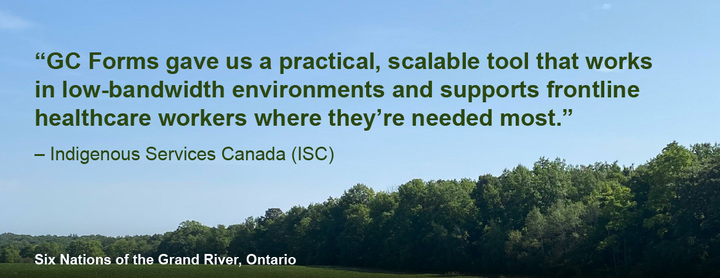
Indigenous Services Canada (ISC) works with Indigenous partners to deliver primary healthcare services in communities where access may be limited.
One of ISC’s partnership initiatives is nursing. As the primary contact and providers within communities, nurses need to gather information and data that can help them track health issues and trends across communities. To better support this work, ISC introduced GC Forms, enabling teams to spot trends earlier and respond more quickly with targeted support.
Read our blog collaboration with ISC to learn about the importance of this work:
- The Challenge: Limited visibility into nursing workload and health trends made it difficult to proactively respond to community needs.
- The Solution: A standardized, secure form used by nurses to capture and share structured data across communities.
- The Impact: Earlier identification of trends and more timely staffing and resource decisions, supporting more responsive and equitable care.
Challenge: Limited data standardization and visibility across nursing operations
ISC needed a way to consistently capture and analyze the nursing workload and health trends, across approximately 30 nursing stations serving 30 communities across Canada.
Before implementing GC Forms, data collection and analysis was manual or fragmented, and information was not consistently structured across communities. A lack of standardized data sets and collection mechanisms made it hard to predict service needs across communities.
Without a consistent view across communities, it was difficult to use data to answer operational questions, such as: How many acute vs non-acute visits are occurring? Are certain categories of health concerns increasing? Where are staffing pressures emerging? These challenges limited ISC’s ability to proactively respond to changing community needs.
About ISC nursing: providing healthcare services to remote Indigenous communities
Together with leaders of Indigenous communities, ISC actively strives to create a culturally appropriate and high-quality approach to delivering healthcare services.
ISC-employed and contracted agency nurses play a critical role in ensuring the continuity and equity of care in Indigenous communities. They deliver a broad scope of practice, including acute care, chronic disease management, public health, preventative care, and emergency response.
Solution: GC Forms enables efficient data intake from nurses
“The form-building process was intuitive. We were able to design exactly what our nursing teams needed, without relying on technical specialists.”
With GC Forms, data collection became more consistent and easier for nurses to complete as part of their day-to-day work. Instead of fragmented or manual processes, information could be captured in a structured way and shared across communities.
This improved visibility allowed ISC teams to more quickly identify emerging trends and respond with targeted support where it was needed most.
GC Forms supports this by enabling standardized forms that adapt to each healthcare encounter. Using conditional logic, nurses are only shown the fields relevant to their situation, reducing unnecessary data entry and improving the consistency and quality of the data collected across communities.
Because GC Forms is designed to securely capture personal information, including Protected B data, it provides a trusted way to collect and transmit the sensitive health information required for this use case.
What the form captures (high-level)
The form supports internal quality assurance and workload monitoring by capturing standardized, encounter-level data, including:
- Nurse designation and community.
- Type of visit (where applicable: acute, non-acute, public health, administrative, and triage).
- Location of care (nursing station, home, phone, virtual, and community setting).
- Visit timing and acuity.
- Broad categories of health concerns.
- Whether consultations or medevacs were required.
How ISC uses the data for improved service delivery
“Before GC Forms, we lacked a consistent way to track local health issues across communities. Now, we can spot trends early and respond faster with targeted support.”
The data collected through GC Forms supports:
- Quality assurance of nursing services.
- Workload monitoring across communities.
- Trend analysis to identify patterns in emerging health needs.
- Staffing and resource decisions, informed by real encounter volumes and acuity.
In practice, this means:
- Communities experiencing increased demand or higher acuity can receive adjusted staffing support.
- Differences in workload between nursing stations (some staffed by 2 nurses, others by up to 12) become visible and comparable.
Since implementing GC Forms, this approach has generated a growing body of data to support these decisions, including:
- 51,127 submissions captured across 30 remote communities for FY 25-26.
- 30,658 health concerns documented during nursing visits in FY 25-26.
- 25,520 consults recorded in FY 25-26.
Together, these figures reflect thousands of healthcare interactions across communities, helping ISC build a clearer picture of care needs and respond more effectively.
These improvements have contributed to:
- Improved visibility into nursing workload and service delivery.
- Reduced administrative burden for nursing staff.
- Faster identification of emerging health trends.
- Greater flexibility to adapt forms as needs evolve.
- Stronger evidence base to support equitable staffing and resource allocation.
While the form is used internally, these improvements contribute to more responsive and equitable healthcare delivery in remote Indigenous communities.