
“Plain language is a writing approach to communicate what your audience needs to know. With plain language, the wording, structure and design are so clear… [it] makes critical information more accessible and easy to read. It doesn’t oversimplify or strip meaning from content. Instead, plain language content is clear, concise, and designed to save the intended audience time and effort.”
– Canada.ca Content Style Guide
The Digital Transformation Office (DTO) at the Canadian Digital Service (CDS) is responsible for the design of Canada.ca. This includes the Canada.ca Content Style Guide and its updated guidance on writing in plain language.
In this blog, we’re sharing recent updates we published on plain language guidance to help the Government of Canada (GC) community write clear web content. Before we explain these updates, we want to share information about the importance of the guide, as well as the coordination process for updates and who was involved.
Meet the CDSers who led this initiative
Chelsey Donohue
I’m currently the Acting Chief of Product Design and Standards at DTO. Before joining this team, I spent almost 15 years as a web communications advisor, so I used the Canada.ca Content Style Guide often.
In that role, I helped to redesign and rewrite our department’s intranet. We ensured the entire intranet was written in plain language which involved a lot of change management and training colleagues across the country. This experience helped me learn how to better demonstrate the principles of plain language. In my time at DTO and working as a communications advisor, I’ve been very fortunate to learn from many of the people in the GC plain language community.
Anne-Sophie Dumetz
I’m a Senior Content Advisor for Partnerships at CDS. I started writing in plain language as a journalist in 2004, and later, as a senior communications advisor and editor of the Style Guide at the Canadian Museum of History. In these roles and others in the private and public sector, we used plain language techniques to say things clearly and simply, so those who read or hear our content could easily understand what we’re communicating.
Being clear is the kindest, best thing we can do for those who are paying attention to what we’re communicating. Plain language techniques help us do just that.
What is the Canada.ca Content Style Guide?
The Canada.ca Content Style Guide shares writing techniques and principles to create web content people can easily find, understand, and use. It helps teams ensure language and formatting is consistent across the Government of Canada (GC) web ecosystem.
The style guide complements the rules in Writing Tips Plus, a reference tool produced by the Language Portal of Canada. It’s useful to anyone wanting to understand and follow best practices for communicating online. Our DTO team manages the guide and works with subject-matter experts in the GC web community to revise and implement essential revisions.
How teams use the style guide
Every day, teams across the government are writing new web content that will be read by the people we serve. The style guide is an essential resource that helps new and seasoned writers plan, produce, and publish clear, easy-to-understand content. Members of the GC community often reach out with questions, advice, and recommendations to help us improve the style guide. DTO tracks every suggestion and we do our best to review and implement a few key ones every year.
Why the style guide matters
People read differently online. They don’t read word by word. Instead, they often scan content to find the words or links they need to do what they came to do. This is especially true on a government website, where people want to find information about programs or services that matter to their unique situation.
The style guide helps writers understand how to adapt the writing and formatting to an online audience. It includes useful information on how to write for accessibility, readability, and usability. The good news? Plain language principles stay mostly unchanged, whether you’re communicating with your audience online or in print.
As a GC communicator, it’s your job and duty to publish web content that is easy to find, understand, and use. The guide is designed to support you while you do this.
Making the plain language guidance more useful
In 2023, the International Organization for Standardization (ISO) published the world’s first international plain language standard, notably leaving out readability formulas. You can learn more about the ISO plain language standard in this GC Our Languages blog.
When these international guidelines were published, Canada’s style guide still recommended using readability formulas, so we decided to update our guidance. At the same time, we reviewed and refreshed the rest of the plain language section to make it more relevant for everyone. Our goal was to make the plain language guidance as useful as possible for every public servant writing content for Canada.ca and other products.
Behind the scenes: How we collaborated to update the plain language guidance
In August 2024, our updated plain language section was published to the Canada.ca Content Style Guide. Getting there was a true collaborative effort.
Here’s how we got there:
- Created a bilingual plain language working group: plain language experts from across the Government of Canada came together to review and suggest improvements to the section. Having experts in English and French was essential since the rules are unique to each language. Many members are also active in the GC Plain Language Community of Practice.
- Worked openly, collaboratively: our team and the working group, both together and individually, reviewed and suggested changes to improve the section. By the end, we had over 100 versions of the documents! Before publishing the final content, we reviewed and discussed any conflicting suggestions.
- Received input from other CDS language experts: the CDS Content Design Community of Practice and the Linguistic Services team reviewed our almost final version.
- You can read about how their feedback styles improve content in the blogs on content critiques and inclusive French writing.
- You can read about how their feedback styles improve content in the blogs on content critiques and inclusive French writing.
- Engaged with Accessibility Standards Canada and reviewed our content against their draft standard on Plain Language.
- Coordinated with the Treasury Board of Canada Secretariat (TBS) to remove recommended reading levels from the Guidelines on Making Communications Products and Activities Accessible.
Impactful updates made to plain language guidance
Re-structured the guidance on plain language to be easier to understand and navigate (section 2.0)
Old structure: Not as easy to scan
We wanted the guide to have a more useful structure with information that’s easy to follow.
We needed to start with the most important information: Be direct, brief, and write easy-to-scan content.
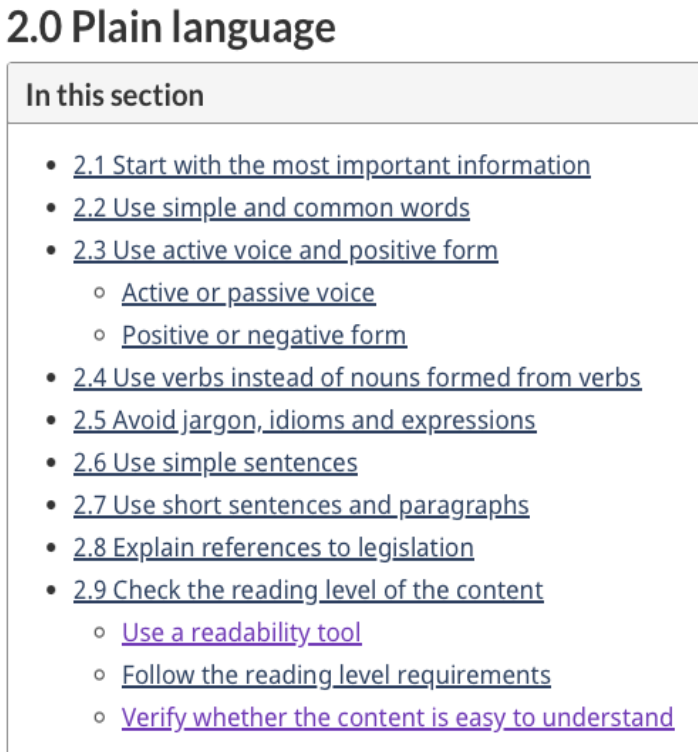
Screenshot of the previous plain language table of contents. The content wasn’t easy to navigate.
New structure: Beginner-friendly and easy to navigate
A few examples of the changes we made:
- Adjusted the structure and names of subsections to make them clear and easy to understand. The table of contents now has more subsections to group the information, making it easier to find (sub)topics quickly.
- Added the new “Getting Started with plain language: writing for readability” section at the start of the guidance. Before, we had checklist-style information at the end, it’s now at the start to be more beginner-friendly and expanded with more useful content. It’s a great section to print and keep by your desk as a job aid, or bookmark in your browser.
- Made plain language resources easier to find by moving them up from the appendix to the new, enriched resources subsection.
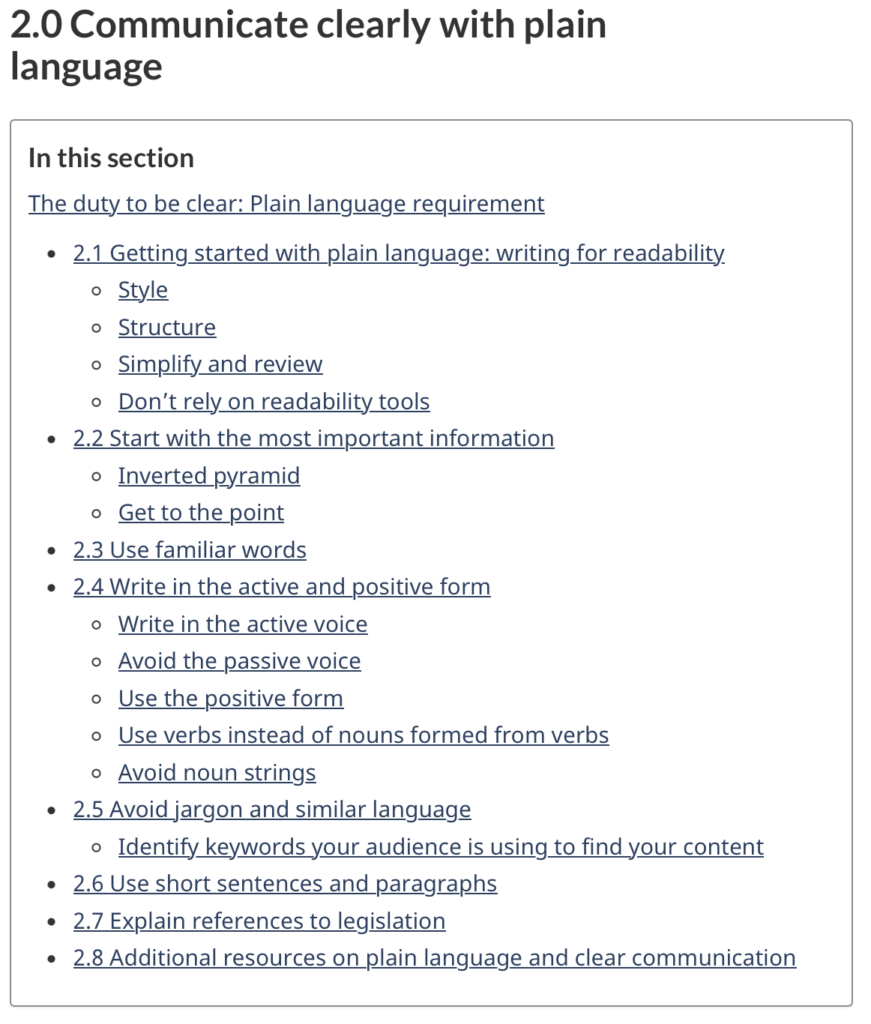
Screenshot of the updated plain language table of contents. It now has expansive, easily navigable content.
Made the rationale for plain language more compelling (section 2.0)
Using plain language isn’t about oversimplifying. It’s making sure everyone can easily understand the message. We all benefit from it. We wanted that written out for people who don’t work with plain language all the time.
So we added the The duty to be clear: Plain language requirement as a clearer, more compelling rationale; it’s our job to be clear so we can be understood.
Changed guidance: Don’t rely on readability tools (section 2.1)
Previously, the Canada.ca Content Style Guide and TBS’s Guidelines on Making Communications Products and Activities Accessible had recommended readability levels.
Research shows that readability formulas don’t work because they:
- Aren’t created for technical documents.
- Assume that short words are always the better words.
- Can result in different/conflicting scores from different programs.
- Don’t work with many documented features of plain language, such as deciding what content is right for your readers, organizing it in the way that makes most sense for the audience, using standard formatting (such as bullets and headings) to guide people through content, etc.
We realize that some writers find readability tools a helpful first step to identify some areas that need work. You can still use readability tools, we’re just recommending that you don’t rely on them to accurately evaluate how easy it is to read and understand content.
Simplified the inverted pyramid diagram for how to order content on a webpage (section 2.2)
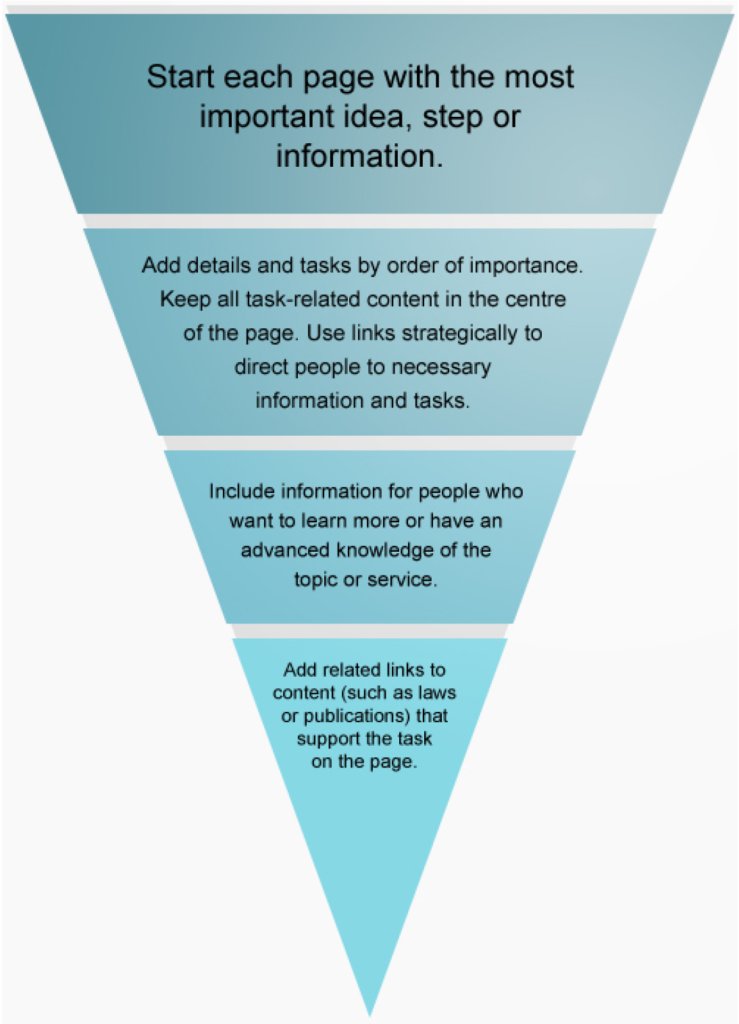
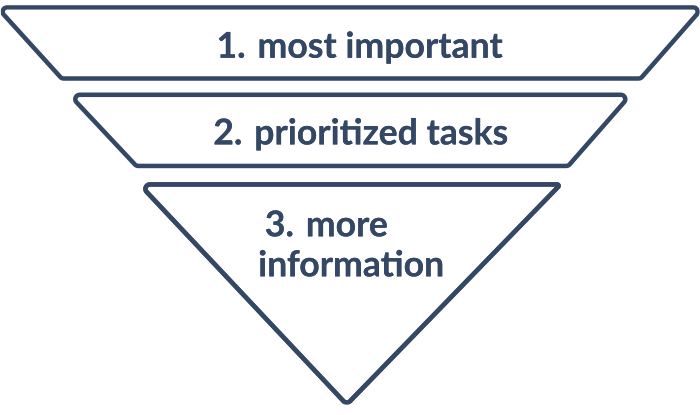
The inverted pyramid diagram shows a writing technique for how to order content on a webpage. The previous diagram presented most of the guidance within an image, which is not an accessibility best practice.
So we updated the image to be less text-heavy and refined the guidance to be more simple and clear. We moved content out of the image, simplified the instructions, and merged related links and more information.
Before: Text-heavy diagram
Now: Simple + clear = easy to understand & apply
Added guidance for explaining a technical term (section 2.3)
Our previous guidance didn’t include guidance on how to explain a technical term, but these are common in GC content. So we added an example for how to do this. Now, we advise that if you need to include technical terms, explain them using concise, clear, easy-to-understand words or give an example to help non-specialists understand.
Check out the updated guidance and share with GC colleagues!
We encourage you to read through Section 2.0: Communicate clearly with plain language and share with your colleagues. If you have standups, or shared team messaging spaces, we’d appreciate you sharing the style guide and letting people know that there’s some great new guidance about plain language.
This guidance is valuable whether you’re creating web content or writing other products. If you have questions or feedback on the guidance, contact DTO.
Also, we’d like to say a huge thank you again to everyone who helped with this process. The updates wouldn’t have been possible if it wasn’t for passionate plain language advocates within the GC.